Quick answer: The cheapest strata painting quote often costs the most because the low price usually comes from cut prep, fewer coats, cheaper paint or missing licensing. On common property, an early failure means paying to scaffold and repaint the whole block a second time.
Key takeaways
- A quality exterior repaint should last 7 to 10 years. A corner-cut one can fail in under 3.
- Cheap quotes almost always save on prep hours, coat count, paint grade or licensing, not on genuine efficiency.
- Access (scaffold or elevated platform) is a fixed cost paid again on every re-do, which is what makes early failure so expensive on strata.
- Unlicensed work above state thresholds ($3,300 to $12,000, depending on the state) can strip owner protections and shift liability.
- A cheap quote built on the same itemised scope as its rivals can be real value. The danger is the quote that is cheap because work was removed.
- Key takeaways
- What makes one strata painting quote cheaper than another?
- Why is surface prep the first thing cheap painters cut?
- How coats and paint grade change the price
- Do strata painters need a licence and insurance?
- Why access makes strata different
- Which warranties actually mean something?
- Cheap quote vs properly scoped quote
- How to compare quotes on total cost
- When is the cheapest quote actually fine?
- The bottom line
- Frequently asked questions
A quality exterior coating system on a strata block should hold for seven to ten years. A corner-cut one can start peeling in under three years. For an owners corporation, that gap means paying to erect access equipment twice, and access is usually the single largest cost on the whole job.
The same access-driven cost logic applies to roof painting cost calculations on strata blocks, where scaffold or rope access often outweighs the price of the coating itself.
Strata committees almost always collect three quotes and lean toward the lowest to protect the capital works fund. That instinct is reasonable. The problem is that the number on the front page rarely reflects the total cost of the decision.
The exterior of a strata building is common property. When a cheap job fails early, every owner shares the redo bill plus the cost of setting up the site again. This article shows where a low quote quietly loses its value, and how to spot a genuinely lean quote versus one that is cheap because critical work was left out.
What makes one strata painting quote cheaper than another?
Two licensed painters looking at the same building land on similar labour and material costs. So when one quote comes in thousands lower, the money came out of something specific.
There are only four levers a painter can pull to drop a price:
- Cut preparation hours. The largest block of labour, and the easiest to hide.
- Reduce the number of coats. Invisible on day one, obvious within a year.
- Switch to cheaper paint. Fewer solids, thinner film, shorter life.
- Skip proper access, licensing and insurance. Real savings, real exposure.
None of these appear as a line saying “we removed this.” They show up as a smaller total, and the committee learns which corner was cut only after the finish starts failing.
Why is surface prep the first thing cheap painters cut?
Preparation is the biggest block of labour hours on almost any repaint, which makes it the easiest place to hide a discount. Washing, sanding, scraping loose paint, treating mould, filling cracks, sealing gaps and priming all happen before a single litre of finish goes on.
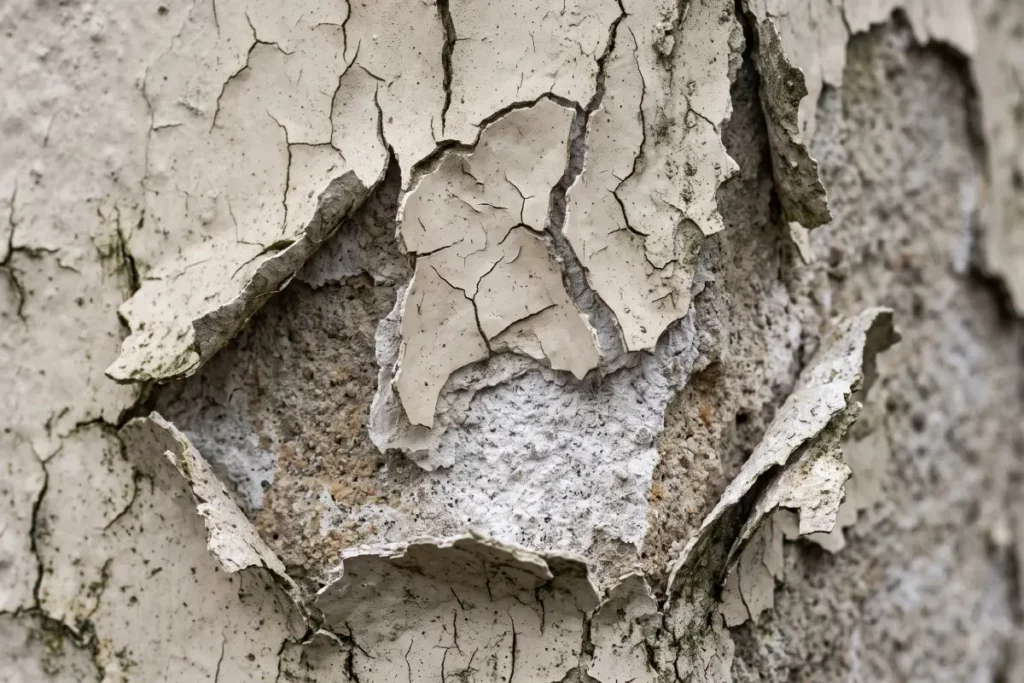
Paint fails from the surface, not the tin
When prep is rushed or skipped, the new coating has nothing stable to bond to. It peels, bubbles and flakes, usually starting at edges and around old repairs. On a rendered facade exposed to weather, a touch-up will not hold, and the building needs the whole surface stripped back and redone.
The tell in the quote
A line reading “two coats exterior acrylic” tells you nothing about whether the surface gets cleaned, primed or repaired first. A quote worth trusting itemises the prep steps by name.
How coats and paint grade change the price
Most exterior surfaces need two full finish coats over primer to reach even colour and the film thickness the paint is rated for. Dropping to a single coat is invisible when wet and obvious within a year.
The one-coat trap
A one-coat job looks fine on handover. As it cures and the light changes through the day, patchy coverage, thin spots and colour differences near corners and windows show through. The fix is another full coat over the whole building.
The paint-grade trap
Cheaper paint carries fewer solids, so it covers less and forms a thinner, more fragile film. Some operators also thin paint to stretch it, which weakens adhesion and cuts life sharply. Insist the quote names the exact product and line, not a generic “premium exterior paint.”
Do strata painters need a licence and insurance?
In most of Australia, yes, and the thresholds are low enough that nearly every strata job clears them. In NSW, a contractor licence is required for any painting work over $5,000 in labour and materials, with the Queensland (QBCC) threshold at $3,300 and South Australia at $12,000.
Why unlicensed looks cheaper
An unlicensed operator quotes less because they carry none of the cost of holding a licence or the insurance that comes with it. Using one above the threshold can cut the owners corporation off from statutory protections such as the NSW Home Building Compensation scheme, which applies to residential building work over $20,000.
What to require for work at height
For common property at height, public liability cover matters as much as the licence. Strata bodies are commonly advised to require a minimum of $20 million public liability, plus a Safe Work Method Statement supplied before work starts. If a painter is not insured for the job, an accident or building damage can become the owners’ problem.
Why access makes strata different
On a multi-storey block, getting to the surface safely is often the biggest single cost, ahead of paint and sometimes ahead of labour. This is what separates strata from a standard house repaint.
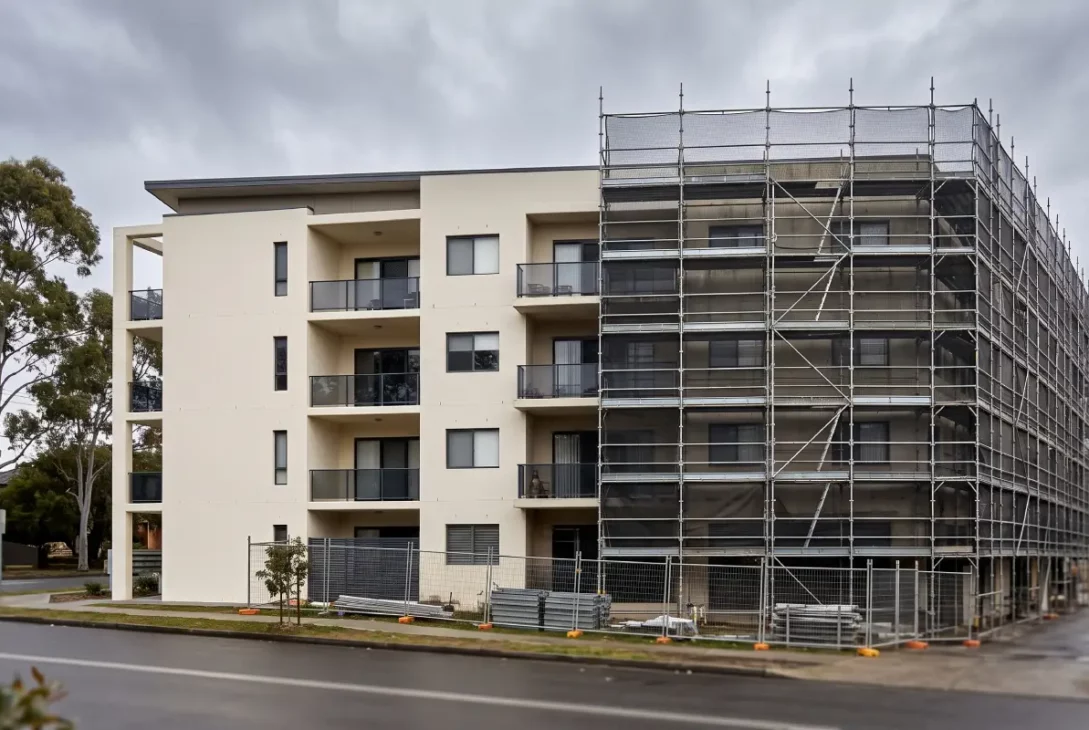
Scaffolding, elevated work platforms or rope access are non-negotiable above ground level, and hire for even a two-storey job commonly runs $1,500 to $5,000 before anyone lifts a brush. On a five-storey building needing scaffold on several sides, it becomes a major line on its own.
Here is the trap. Access is a fixed setup cost, paid whether the paint lasts ten years or two. If a cheap job fails early, the owners repay not just for paint and labour but to erect the entire access system again. A quote that looks $8,000 cheaper can wipe out that saving many times over the moment it triggers a re-mobilisation.
Which warranties actually mean something?
A warranty is only as good as the entity standing behind it, and two separate promises are in play: the manufacturer’s product guarantee and the contractor’s workmanship warranty.
Product guarantees are conditional
Premium exterior systems such as Dulux Weathershield and Haymes Solashield carry manufacturer guarantees of roughly 15 to 20 years. The catch is that they depend on the paint being applied to specification, so cutting prep or coats can void the very guarantee that sold the product.
Workmanship warranties depend on the business
Workmanship warranties for strata jobs typically run 1 to 5 years, with 2 years being common. A warranty from an uninsured, unlicensed or short-lived operator is worth little, because there may be no business left to honour it when a problem appears in year three. Read the terms as carefully as the price.
Cheap quote vs properly scoped quote
Same building, same scope on paper. The difference sits in the detail the committee has to ask for.
| Line item | Budget quote | Properly scoped quote | Why it matters |
| Surface prep | “Prepare surfaces” (unspecified) | Wash, mould treat, sand, fill, spot-prime, named steps | Prep is the biggest labour block and the main cause of early failure |
| Coats | Not stated, often one | Two full finish coats over primer | One-coat coverage fails within a year as it cures |
| Paint system | “Premium exterior acrylic” | Named product and line, stated coat count | Named products are rated and warrantied; generics are not |
| Access | “Ladders as required” | Scaffold or EWP spec, safe for the height | Access is a fixed cost; getting it wrong is a safety and re-work risk |
| Licence and insurance | Not shown | Licence number plus public liability cover stated | Unlicensed work can void owner protections and shift liability |
| Workmanship warranty | Vague or none | Written term, 2 years or more, from a contactable business | A warranty is only worth the business behind it |
| Likely lifespan | Under 3 years if corners cut | 7 to 10 years | Early failure means a full re-do, including access, again |
The budget column is not always a scam. It is a quote with unanswered questions, and every blank is a place cost was removed.
How to compare quotes on total cost
The goal is to make every quote describe the same job, so price becomes the only variable. Standardise the scope before you compare dollars. Sydney-based operators such as Pro Plaster N Paint in Sydney are used to itemising scope this way for strata committees, which makes the comparison easier for everyone at the table.
- Send one brief to every painter so the quotes are like for like.
- Require itemised detail: prep steps by name, exact paint product and line, coat count, access method, and written exclusions.
- Verify the licence on the relevant state register and request the public liability certificate with its expiry.
- Divide price by expected life. A higher-priced repaint over eight to ten years often costs less per year than a cheap one redone inside three, especially once you add the second access setup.
- Ask for references from comparable buildings. A contractor ready for strata has all of this on hand before you award the job.
When is the cheapest quote actually fine?
Cheapest does not automatically mean worst. A low quote is the right choice when the reason for the low price is transparent, not hidden.
A smaller local operator with low overhead, quiet timing between larger jobs, or a building with easy single-storey access and sound existing surfaces can each produce a genuinely lower price on the same honest scope. There, the saving comes from real efficiency, not omitted work.
The test is simple. If the cheapest quote itemises the same prep, coats, named product, access and licensing as the others and is still lowest, it may be the best value on the table. The danger is only the quote that is cheap because something was left out.
The bottom line
The cheapest strata painting quote often becomes the most expensive because the saving usually comes from work you cannot see on the page: preparation hours, a second coat, paint grade, licensing, insurance and safe access. Each of those is what makes the finish last, and cutting them is what makes it fail early.
On common property, early failure costs twice, because the owners repay not just for paint and labour but for setting up access all over again. A coating that should last seven to ten years, redone inside three, can erase any upfront saving several times.
The honest answer is that price alone tells you nothing. A cheap quote built on the same itemised scope as its rivals can be excellent value. A cheap quote that is cheap because prep, coats, product, licensing or insurance were quietly removed is the one that comes back to cost the most. Compare the scope first, then the price.